Jev AI Explained: The New AI Model That Doesn't Write Text
Jev is a new AI model that returns fast, typed decisions instead of text. Here is how it works, what it costs, and what independent tests found.
Abdul Rehman·Oct 3, 2026·10 min read
"What if an AI never wrote a single word, yet quietly made thousands of smart decisions for you every minute?"
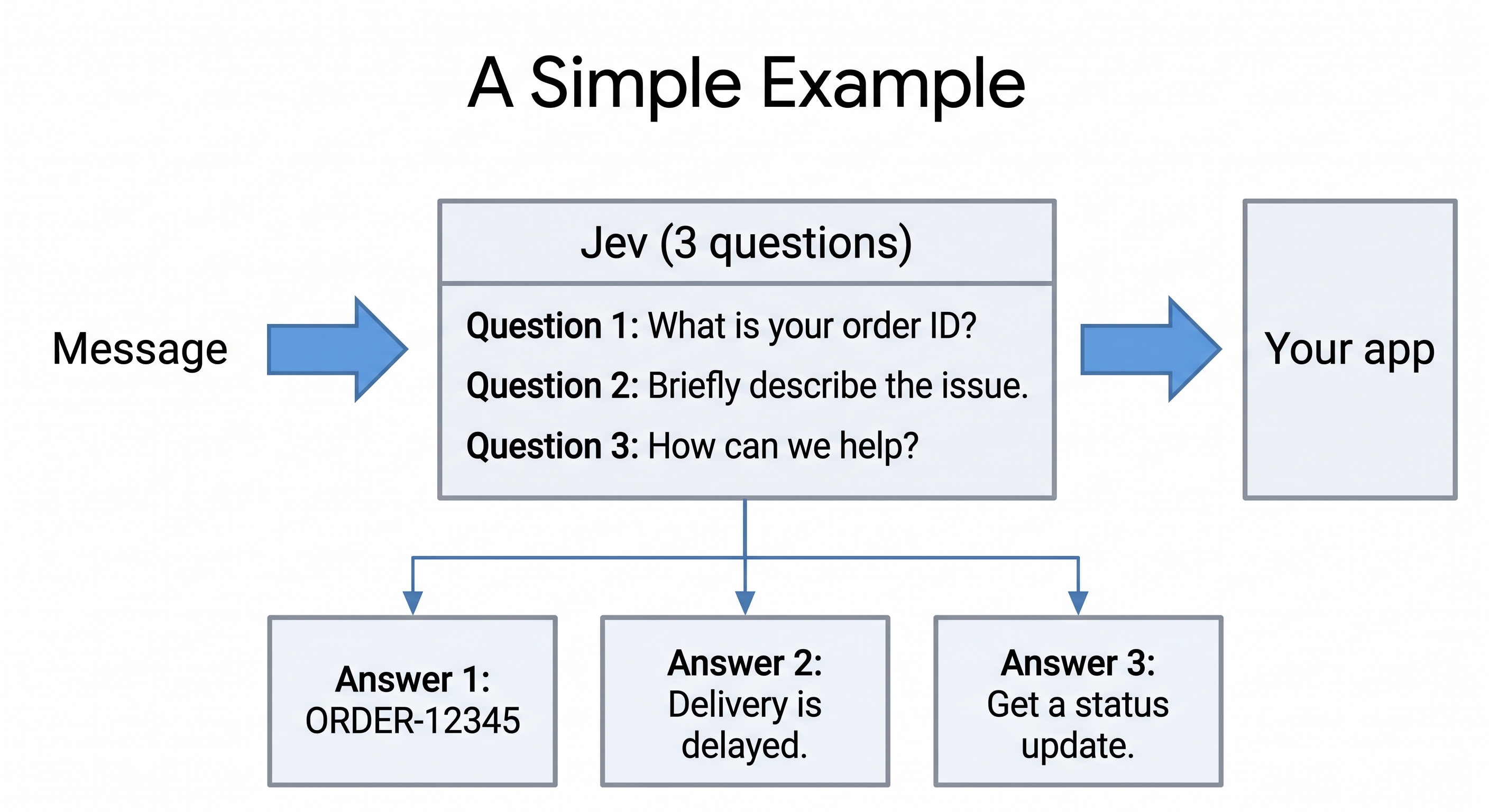
Illustrative example of how a decision model sorts a customer message.
A customer types, "My parcel is 5 days late and I want a refund." Before any human reads it, software has to make a small decision: is this a shipping problem or a billing problem, and does it need attention today? Most companies handle that with rigid rules, or by asking a chatbot to write an answer and then reading that answer with more code.
Jev, a new model from TypeSafe AI, skips the writing. It simply answers: shipping, high urgency, refund likely. No paragraph, no polite introduction, just a decision your software can use right away.
Quick Summary
What it is: a decision model that returns typed answers with probabilities instead of text.
Who made it: TypeSafe AI, a San Francisco lab that launched it on September 15, 2026.
Why people care: it is very fast and very cheap for repeat decisions like routing, scoring and moderation.
The catch: most numbers are self-reported, independent tests show real limits, and it cannot write or chat.
What Is Jev AI?
Jev is TypeSafe AI's first "System One" model. You give it a piece of information, called the state, and a set of questions you defined in advance. It returns answers in a fixed format, each with a probability. It does not write sentences, code or explanations.
There are three kinds of questions it can answer:
Choice: pick one option from a list, such as billing, shipping or other.
Score: place something on a scale or rubric, such as low, medium or high urgency.
Yes or no: give the probability that a statement is true.
OpenAI's always-on Dots agent explained: how it works, who gets it, and how it holds up in early use.
Abdul Rehman·Oct 2, 2026·10 min read
Developers call it through one API endpoint. At launch it was in early access with a waitlist, and TypeSafe says more System One models are coming.
Jev vs ChatGPT, Claude and Gemini
Chatbots are built to write. Their answer comes out word by word, and an app then has to read that text and turn it into a decision. Jev flips this: the app asks for a decision in a defined shape, and gets exactly that shape back. TypeSafe also says Jev answers all questions in a request in parallel, instead of generating them one token at a time.
Chatbots like ChatGPT, Claude, Gemini
Jev
Output
Free-form text
Typed choices, scores and probabilities
Best at
Writing, explaining, coding, chatting
Fast, repeated decisions inside software
Speed
Seconds, depending on the answer length
70 to 500 milliseconds, per TypeSafe
Price
Varies by model
$0.042 per million input tokens, output free (launch price)
Can write an email?
Yes
No
So Jev is not a ChatGPT replacement. It is closer to a specialist that sits inside an app next to a general model.
A Simple Example
Going back to the late parcel, a developer could define three questions once:
Refund eligible? Yes or no, with a probability.
Urgency? Low, medium or high.
Which team? Shipping, billing or other.
Jev returns all three answers together. The app can then route the message, start a refund workflow, or flag it for a person, with no text to parse. TypeSafe's own examples cover similar jobs: security alerts, customer-service routing, invoice handling and checking what AI agents are doing.
Why Is It Called "System One"?
The name comes from Daniel Kahneman's book Thinking, Fast and Slow, where System One is quick, intuitive thinking and System Two is slow, deliberate thinking. TypeSafe uses it to say that Jev makes fast, focused judgments, while chat models do slower, wordier reasoning. This is the company's own framing, not an official scientific category.
What Is New Inside Jev?
TypeSafe says three things work together: a new model design, a parallel way of sampling answers, and a training method it calls RLCD, short for Reinforcement Learning for Calibrated Decisions.
Chat models are commonly tuned with RLHF, which rewards answers that human raters like. RLCD instead aims for calibrated probabilities, meaning that when Jev says it is 80% sure, it should be right about 80% of the time. Questions in one request are also evaluated independently, so one answer cannot influence another.
Two cautions apply:
TypeSafe has not published a technical paper on how Jev works, and one researcher criticised the launch for having no paper, open weights or open training data.
Claims that Jev "cannot hallucinate" are narrower than they sound. It cannot return an invalid answer, but it can return a valid answer that is wrong.
Speed and Cost: What the Numbers Really Say
The headline numbers are striking. TypeSafe lists response times of 70 to 500 milliseconds, and independent measurements have landed around 0.35 seconds. The launch price is $0.042 per million input tokens with no charge for output.
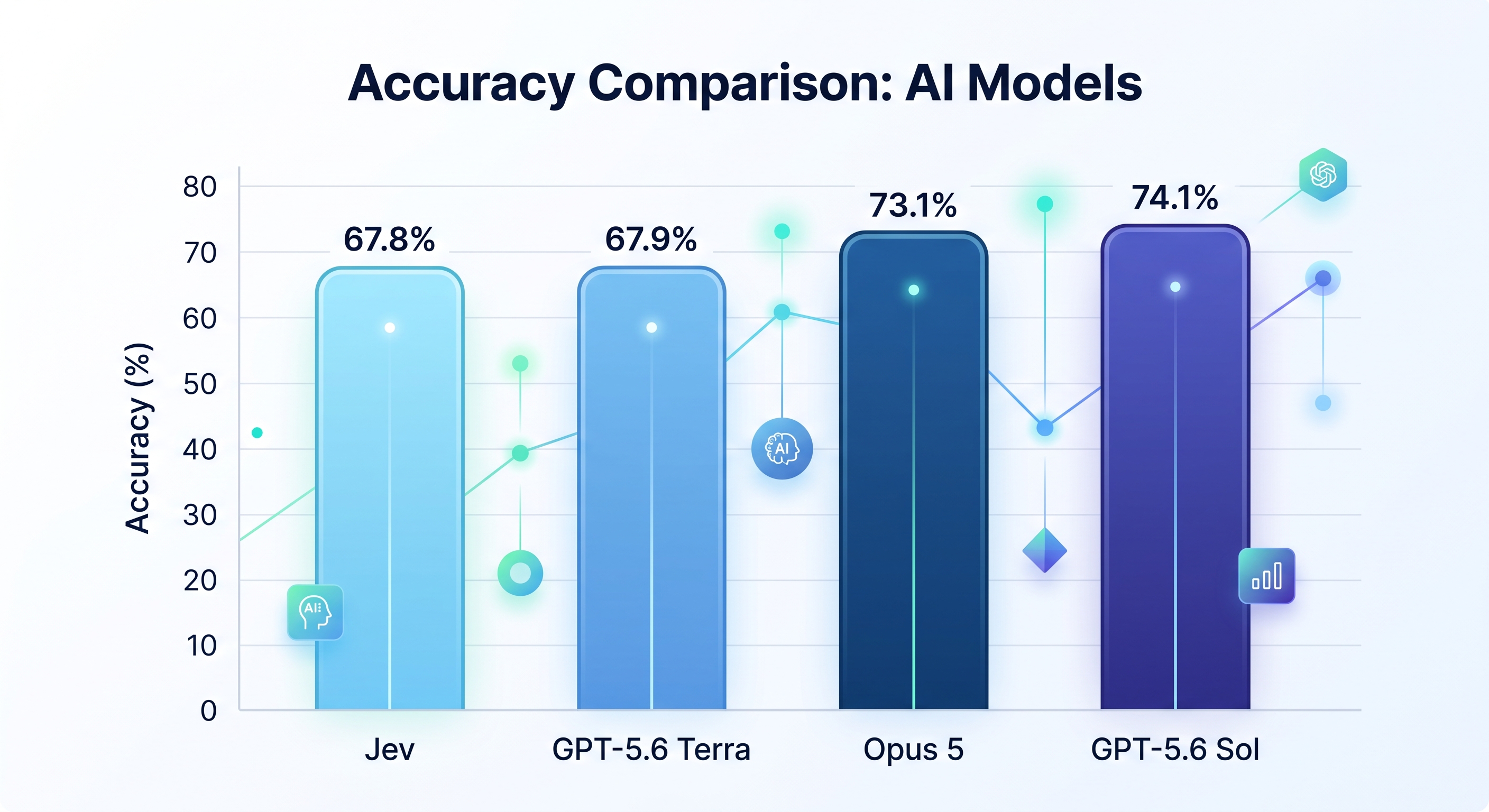
In TypeSafe's own test of four workflows (security incidents, agent-trace review, invoices and customer service), Jev averaged about 68% agreement with reference answers. That was roughly level with one mid-tier GPT-5.6 model and a few points behind the strongest models, at around 1/200th of the cost and 1/50th of the delay.
Accuracy comparison: AI Models
"Accuracy in TypeSafe's own four-workflow test. The reference answers came from other AI models, so treat the gaps as indicative."
The important detail is that TypeSafe designed and ran this test itself, and the reference answers came from other AI models. Treat it as a strong claim, not a final verdict. Bigger models still win when peak accuracy matters on a low-volume task.
What Independent Testers Found
Outside researchers began testing Jev within days.
A 37-dataset study on arXiv ran 346,009 requests for under $10. Jev beat the open model Qwen on 27 of 37 datasets and Gemma on all 37. The authors found its choice probabilities were well calibrated, but yes/no probabilities needed tuning, and performance dropped on harder, noisier tasks. TypeSafe itself says English is Jev's main language.
An early review of the evidence found Jev level with mid-priced LLMs and behind the frontier, and noted that TypeSafe had not published calibration numbers such as a reliability plot.
A small 78-case test put Jev at 0.974 accuracy, ahead of open rivals, though an open model called Laya was far faster at about 30 milliseconds against roughly 302 for Jev.
These are early, mostly unrefereed results from the first weeks after launch.
What Jev Is Good For
Jev fits any job where software must make the same kind of judgment again and again:
Routing support tickets and messages to the right team
Scoring priority or risk using a rubric •
Moderating content for policy problems
Triage of security alerts
Approving, holding or rejecting invoices
Deciding whether an AI-generated answer needs human review
One developer's example shows the scale. A teardown of 724 live ads from 37 brands took about 40 seconds and nine cents, with Jev labelling each ad's hook, format and offer.
What Jev Is Not Good For
If you need an article, an email, code, a long explanation, creative writing or a chat assistant, Jev is the wrong tool. It cannot write prose. Think of it as a hotel receptionist who only points you to Room 12, instead of giving you a speech about the hotel. That is exactly what you want for routing, and useless for storytelling.
A short, usable decision beats a long speech when software is the reader.
Does Jev Replace Humans?
Not by itself. Because Jev returns a probability with every answer, a developer can let it handle clear cases and send uncertain ones to a person. The arXiv study found its choice probabilities support exactly this kind of selective approach. The sensible design is routine decisions by Jev, a confidence check, then human review for doubtful cases.
Is Jev Helpful in Trading?
Jev can help you sort information, but it cannot predict the market.
Jev is a decision model, not a price-prediction model. I found no report of TypeSafe building it for trading, and no independent test of Jev on trading results. So what follows is about how its design might fit, not proof that it works.
Where it could be useful
Sorting news and filings. A choice question could label a headline as earnings, regulation, a lawsuit or something else, and a score question could rate how urgent it is.
Flagging items for a human. A yes/no question could check whether a report mentions a profit warning, so a person reads only the important ones.
Handling volume cheaply. At the launch price of $0.042 per million input tokens, labelling thousands of headlines costs very little.
Where it will not help
It does not know where a price is going. Jev's probability shows how confident it is in its answer to your question, such as "is this headline negative?" It is not the chance that a stock will rise or fall.
Good labels are not the same as profit. A 2026 study of twelve financial sentiment models found that higher classification accuracy does not necessarily mean a stronger link to real economic outcomes.
It is too slow for high-frequency trading. TypeSafe lists 70 to 500 milliseconds per answer, which is fine for reading news but far slower than the speeds high-frequency traders need.
It can be confidently wrong. Most of Jev's accuracy numbers are self-reported, and independent tests show weaker results on noisy, hard tasks. Markets are very noisy.
Can Jev place trades automatically?
ypeSafe's own trading example is more modest than the question suggests. In its function-calling cookbook, a trading assistant turns plain requests such as "compare NVDA, AMD and MSFT over three months" into calls to ten ordinary functions for charts and statistics. Jev picks the right function and its settings and attaches a confidence score. Nothing in that example places an order, sizes a position or shows that the approach makes money.
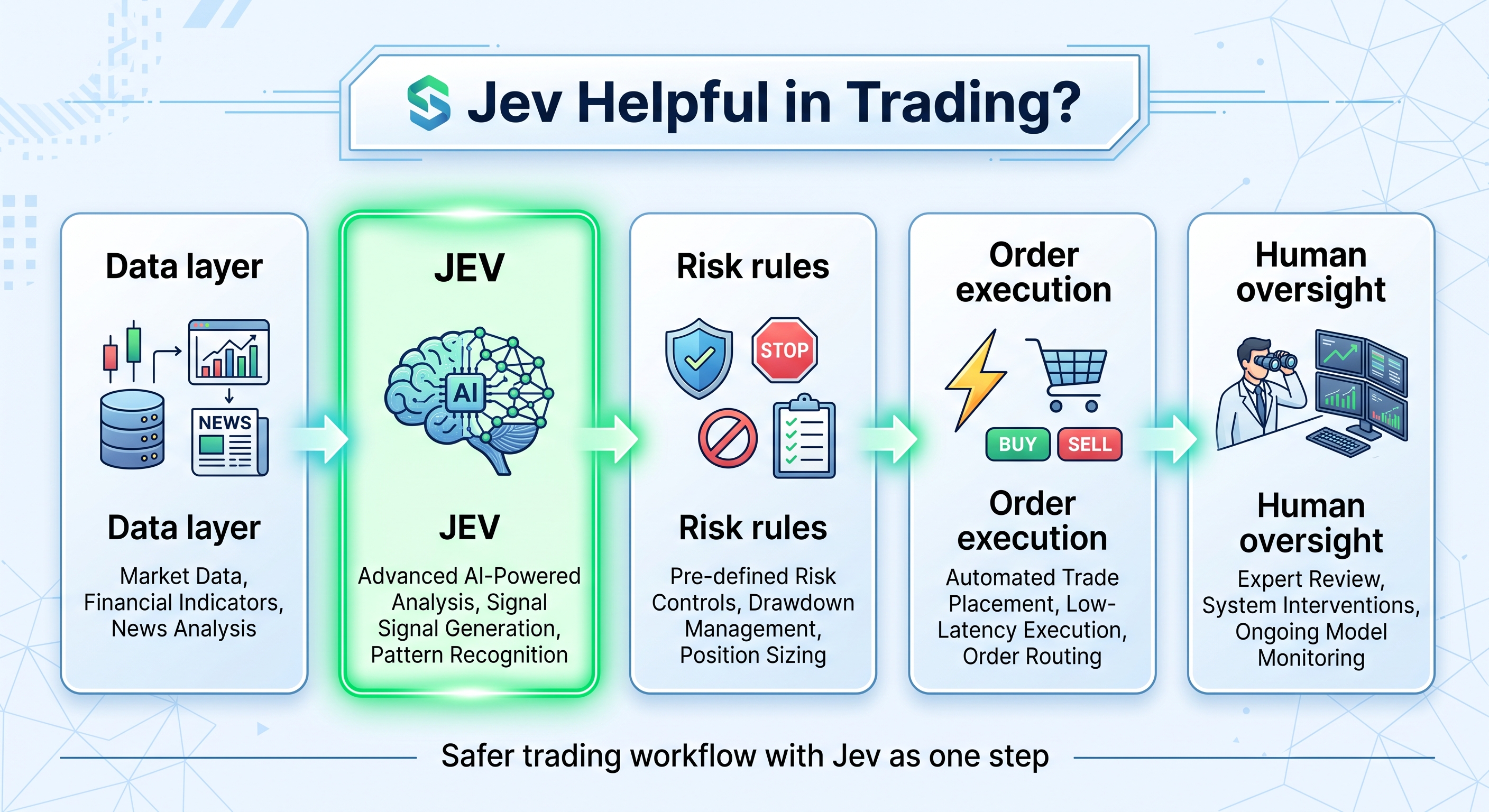
So if anyone builds an automated trading system around Jev, it should be only one part of it. A safer setup keeps the serious work in ordinary code:
Data layer: checks timestamps and calculates indicators the same way every time.
Jev: makes limited judgments with fixed options, such as how relevant a news item is or whether a case needs review. 2.
Risk rules: code sets position size, loss limits and overall exposure.
Order execution: a separate service checks each order before sending it and records what the broker returns.
Human oversight: start in a test mode with no real money, compare against a baseline, and send uncertain or high-impact cases to a person.
Not Financial advice.Trading involves risk,including the loss of your capital.
The sensible way to think about Jev here is as a fast research assistant that sorts a pile of headlines, not as a source of buy or sell signals. If you ever test it, try it on past data or a paper-trading account first, and keep a person making the final call.
NOTE:
"This section is general information only, not financial advice. Trading involves risk, including the loss of your capital."
Who Is Behind Jev?
TypeSafe AI is a private San Francisco company that spent about two years in stealth before launch. Its founders are Diogo Almeida (CEO), Erik Gafni (CTO) and Sasha Sheng (COO). Almeida is described by the company as a co-inventor of the RLHF and InstructGPT work at OpenAI. On launch day, TypeSafe announced $40 million in seed funding led by DCVC.
How to Access Jev
Direct API: early access with a waitlist, through TypeSafe's console, using one endpoint (POST https://api.typesafe.ai/v1/systemone).
SDKs: a Python SDK (Python 3.10 or later) and a TypeScript SDK.
Platforms: within ten days of launch, Vercel, Cloudflare, OpenRouter and Databricks had added access, according to one industry analyst.
Playground: TypeSafe offers an official playground to try questions without writing code.
As of the research for this article, availability and pricing may change quickly, so check TypeSafe's site before building on it.
The Race Jev Started
Jev's launch has been followed by similar ideas elsewhere. Databricks added an ai_decide SQL function that returns a probability, a choice or a score. OpenAI announced a Decisions API running on GPT-6 Luna, in limited invite-only preview, and open-weight attempts like OpenJev have appeared. Whether Jev directly caused these is not established, but it shows the industry is paying attention to structured, machine-readable decisions.
My Take
What I find most interesting is not the speed but the idea: AI does not always have to talk. For a business that handles thousands of messages a day, a small, cheap component that sorts, scores and flags may be worth more than another chatbot. But the early evidence says test it on your own data first, and keep a person in the loop for anything costly.
I come to Jev as someone who has spent years working with machine learning and natural language processing systems, including classifiers, zero-shot classifiers and language models. Honestly, a lot of what Jev does looks familiar to me.
That does not make it uninteresting. TypeSafe AI appears to have built a new architecture and training approach around a very specific problem. But there is a big difference between improving an existing class of NLP systems and inventing an entirely new kind of AI.
We also still know very little about Jev's internal architecture, training setup and model size. For now, many of the biggest claims depend heavily on TypeSafe AI's own benchmarks.
Frequently Asked Questions
What is Jev AI?
Jev is TypeSafe AI's first System One model. It answers typed questions about some input and returns choices, scores and probabilities instead of text.
Is Jev a chatbot like ChatGPT?
No. It cannot write or chat. It is built for fast decisions that software can use directly.
How much does Jev cost?
The launch price is $0.042 per million input tokens, with output free. Access started as an early-access waitlist, so check TypeSafe for current terms.
Can Jev hallucinate?
It cannot return an answer outside the options you define, but it can choose the wrong option. Independent tests show real mistakes on difficult tasks.
Is Jev made by OpenAI?
No. It comes from TypeSafe AI. Its CEO previously worked at OpenAI, but the company is separate and privately funded.
Is Jev connected to any government?
I found no reliable evidence of any government owning or funding it. The reporting describes TypeSafe as a private company backed by venture investors.
Can Jev predict stock prices or help with trading?
No. Jev sorts and scores information, and its probabilities describe its confidence in an answer, not where a price will go. It may help organise news, but it is not a trading signal. This is not financial advice.
Can Jev execute automated trading decisions?
Not on its own. Jev can be one decision step inside a trading workflow, but ordinary code should handle calculations, risk limits and order execution. TypeSafe's own trading example only turns requests into charts and statistics. This is not financial advice.
Conclusion
Jev is not another chatbot. It is a fast, cheap decision engine that turns messy input into typed answers a program can act on. The speed and price claims are impressive but mostly self-reported, and independent tests show it is competitive on many tasks, weaker on hard ones, and unable to write at all. If you build software with repeated judgments, it is worth testing. If you just want an AI to talk to, it is not for you.
Sources
Reporting current as of October 3, 2026; details may change quickly.